
Renting vs Buying: Why “Owning is Always Better” Is a Myth
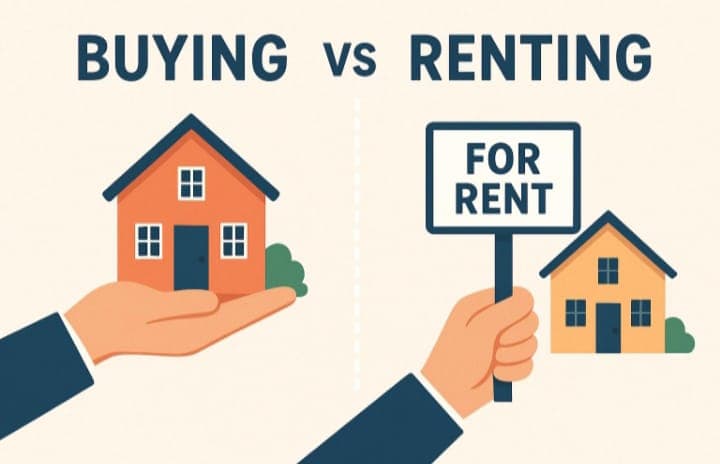
The blog challenges the common belief that buying a home is always financially better than renting, especially in New York City. It explains that high property prices, mortgage rates, taxes, and additional ownership costs can make buying significantly more expensive than renting. Although buying can be beneficial for people who plan to stay in one place for many years, it also requires a large upfront investment and comes with maintenance and financial risks. Renting, on the other hand, offers greater flexibility, lower upfront costs, and keeps capital more liquid. Overall, the blog argues that buying is not always the smarter choice, and the right decision depends on an individual’s financial situation, plans, and priorities.
Introduction
Few financial slogans have aged as well in popular culture as buying is better than renting.
It sounds sensible, disciplined and vaguely grown-up. Buy, and you build equity. Rent, and you are “paying someone else’s mortgage”. But in New York City, that neat little rule starts to wobble the moment you put actual numbers on the page. In a market where purchase prices are punishing, mortgage rates are still elevated, and monthly ownership costs come with extra layers of fees, buying is not automatically the smarter financial move. Quite often, it is the slower, heavier, and more expensive one.
The Growing Gap Between NYC Home Prices and Rents
As of February 2026, the median sale price in New York City was about $880,000. Meanwhile, Zillow’s New York rent data showed average asking rents around $3,600, with its observed rent index for the city at $3,811 by the end of March 2026. That gap matters because buyers are not simply comparing a monthly mortgage payment to rent. They are comparing rent to the full carrying cost of ownership, which in New York is where the real sting begins.
Take a simplified example using that $880,000 purchase price. With a 20 per cent deposit, the loan would be roughly $704,000. At Freddie Mac’s average 30-year fixed mortgage rate of 6.37 per cent on 9 April 2026, principal and interest alone would come to about $4,390 per month. Then add property tax. New York City’s 2026 Class 2 tax rate was 12.439 per cent on assessed value, and Class 2 property is assessed at 45 per cent of market value, which implies an approximate monthly tax bill of about $410 on an $880,000 apartment. Before you even think about insurance, repairs, or building charges, you are already near $4,800 a month.
The Hidden Costs That Make NYC Homeownership More Expensive
And ownership in New York rarely stops there. Condo owners typically face monthly common charges, while co-op owners pay maintenance fees that sit outside the mortgage payment. StreetEasy notes that these charges are an additional monthly cost and that buyers should budget for them with room for increases. Separate analysis based on U.S. Census data puts the New York metro median HOA or condo fee at $558 per month. Add that to the mortgage and tax estimate above, and the monthly carrying cost rises to roughly $5,360, before maintenance surprises, furnishing costs, or the sort of building assessment that always seems to arrive with impeccable timing. Against a rent of roughly $3,600 to $3,811 for the city, the idea that buying is always “cheaper” starts to look more like a slogan than a calculation.
High Upfront Costs and the Long Road to Break-Even
There are the upfront costs, which are where New York turns the screw. StreetEasy’s recent guidance says buyers should be prepared to spend around 4 to 6 per cent of the purchase price on closing costs, with condos generally nearer the higher end. On an $880,000 apartment, that could mean roughly $35,000 to $53,000 on top of the deposit. So the buyer is not just locking in higher monthly costs than a renter. They are also tying up a very large amount of capital on day one, capital that could otherwise stay liquid or be invested elsewhere. This is one reason the breakeven timeline in expensive cities becomes so long. Even broader national commentary tied to Zillow’s analysis now puts the breakeven point around 7 to 9 years in many markets, and as much as 15 to 20 years in places like New York or San Francisco.
Conclusion
Buying is a conditional decision. It makes far more sense when you plan to stay put for a long time, want stability, can absorb the upfront costs without draining your finances, and are comfortable taking on maintenance risk and illiquidity. If you know you want to stay in the same area for a decade, value control over your space, and view housing partly as forced saving, ownership can still be attractive. In that context, the higher initial cost may be worth paying. But renting has its own strengths, and they are often underrated. In New York, renting buys flexibility, lower upfront commitment, and freedom from repair bills, property taxes, and building politics. It keeps your capital mobile. It lets you respond faster to career changes, neighbourhood preferences, or simply the reality that your life at 27 may not look much like your life at 33. In a city built on movement, that flexibility is not a consolation prize. It is a real financial and lifestyle advantage. So no, owning is not always better. In New York City, it can be better, but only under the right conditions. The smarter rule is less romantic and more useful: buy when you are buying time as well as property. Rent when flexibility is worth more than the deed.